 Qurbani
You Brought the Last Meat, Too
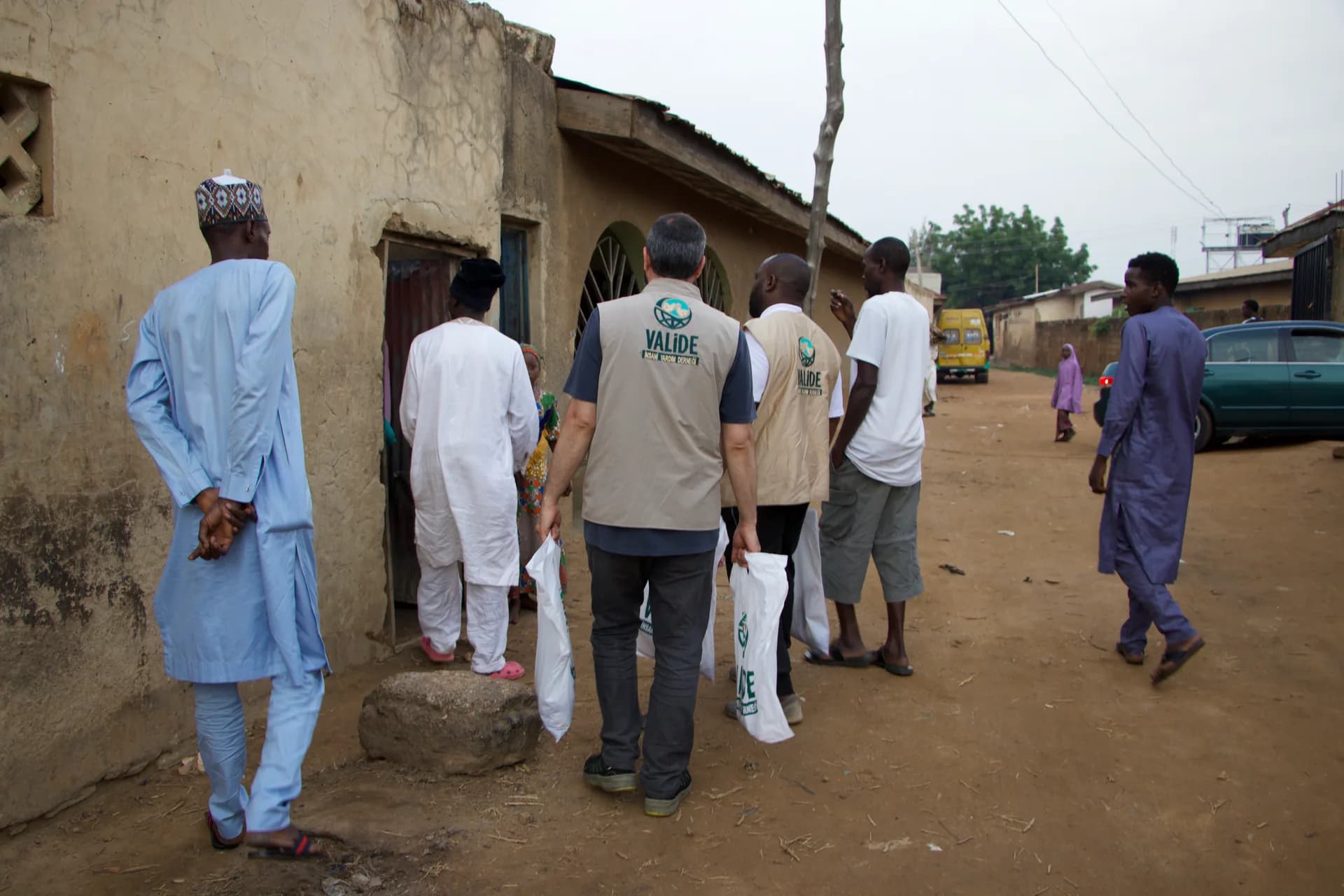
At a Qurbani distribution in Nigeria: a door we knocked on in a narrow street, and one sentence from an elderly woman.
From our field team in NigeriaRead
Water wells, orphan sponsorship and food aid
Nigeria lies on the Gulf of Guinea in West Africa and is Africa's most populous country; its capital is Abuja. According to World Bank data, its population was 237.5 million in 2025; according to a 2020 Pew Research Center estimate, 56.1% of the population is Muslim and 43.4% Christian. The official language is English. According to INSAMER's country profile, the country has more than 250 ethnic groups; the Hausa, Yoruba, Igbo and Fulani are the largest communities. Nigeria is governed as a federal republic; armed conflict continues in the north-eastern states of Borno, Adamawa and Yobe, and the north-west is also experiencing severe food insecurity and protection concerns. Per capita income was US$1,224 in 2025; in 2022, 41.8% of the population lived below the international extreme poverty line of US$3 a day (2021 purchasing power parity). In UNDP's 2025 Human Development Report, Nigeria ranks 164th out of 193 countries.
Nigeria is at the centre of the food crisis in West Africa. According to the Cadre Harmonisé, 36.3 million people, or 16.7% of the population analysed, are facing Phase 3 or above acute food insecurity during the June–August 2026 lean season; this figure represents around two thirds of the regional total. Of these, approximately 2.1 million are in Emergency (Phase 4), and more than 10,000 people in Borno State are in Catastrophe (Phase 5). According to the IPC nutrition analyses cited in the same document, 6.4 million children aged 6–59 months are affected by acute malnutrition. According to data from the Office of the United Nations High Commissioner for Refugees (UNHCR), at the end of 2025 there were 3.5 million internally displaced persons in the country, and some 478,000 Nigerians were refugees in other countries.
According to data from the WHO/UNICEF Joint Monitoring Programme (JMP), in 2024, 82.2% of the population had access to at least basic drinking water, while access to safely managed drinking water was 29.9% and access to basic sanitation 47.9%. According to UN estimates, the under-five mortality rate was 115.6 per 1,000 live births in 2024. According to UNICEF's joint malnutrition estimates, 33.8% of children under five are stunted (2024); in a 2021 survey, the acute malnutrition rate was 11.6%. According to UNESCO data, 24.3% of primary school-age children were out of school in 2023.
The UN's 2026 Humanitarian Needs and Response Plan focuses on Borno, Adamawa and Yobe, the states most affected by the conflict. According to the plan, 5.9 million people in this area are in need of assistance, and the 2.5 million people in the most urgent situation are targeted. According to data from UN OCHA's Financial Tracking Service (FTS), the US$516.4 million plan was 72.9% funded as of 10 November 2026. The plan indicates that 5.8 million people are in need in food security, 4.4 million in water and sanitation, 4.1 million in nutrition and 4 million in health. There are also substantial needs in the north-west, which falls outside the scope of the plan; clean water, food, child nutrition and health services are the most prominent needs across the country.
Sources: INSAMER; UN OCHA (HNRP 2026, FTS); UNHCR; Cadre Harmonisé/IPC (CILSS/FAO/WFP); WHO/UNICEF JMP; UNICEF; UNESCO; World Bank; UNDP; Pew Research Center. Data: 2020–2026.
Nigeria is the country where our field work is most concentrated. In the northern states, above all in Kaduna, Kano and Zaria, we carry out well drilling, orphan sponsorship, food parcel distribution and qurbani organisation.
The well work is planned together with our field partner. The wells that are opened are handed over for the shared use of the village; for each well the location, the opening date and a field photograph are recorded and conveyed to its donor. Once a well is in service it is placed on a maintenance schedule, and fault and repair records are followed through the system.
Alongside the water work, food parcel distribution, the construction of a masjid and education support continue. During the qurbani season, slaughter and distribution are organised with the same field team. The education and care of the orphans under sponsorship in the country are followed regularly.
QurbaniAt a Qurbani distribution in Nigeria: a door we knocked on in a narrow street, and one sentence from an elderly woman.